
 11
11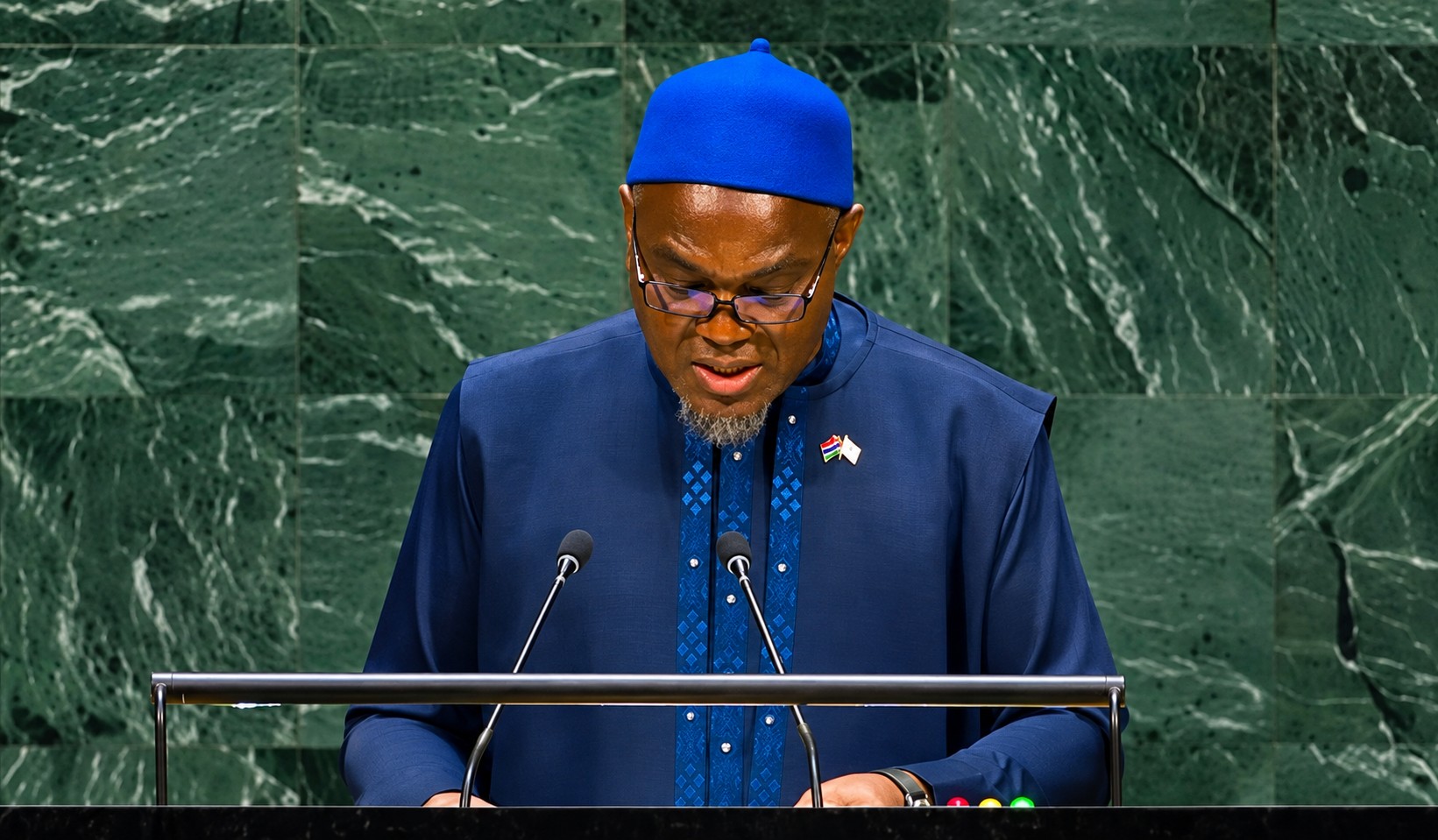
Written by: Seringe S.T. Touray
Vice President Mohammed B.S. Jallow has told world leaders that The Gambia is committed to holding a peaceful and credible presidential election on December 5th, as he addressed the 81st United Nations General Assembly (UNGA) in New York on Thursday on behalf of President Adama Barrow.
In a wide-ranging speech covering The Gambia’s democratic transition, development, electricity, climate change and conflicts around the world, the vice president also called for reforms to the United Nations (UN) and greater representation for Africa in global decision-making.
With Gambians due to elect a president in just over two months, VP Jallow used the international stage to make a commitment on the conduct of the election, pledging a “peaceful, transparent, credible and inclusive” vote.
He also reflected on The Gambia’s political transition following the disputed 2016 presidential election, when former President Yahya Jammeh initially rejected the result before eventually leaving power in January 2017.
The vice president said diplomacy by the UN, working alongside the Economic Community of West African States (ECOWAS) and the African Union (AU), helped defend the choice made by Gambian voters and secure a peaceful transition.
“We have not forgotten that solidarity,” he said, arguing that countries facing similar political crises should be able to rely on international support before situations deteriorate into conflict.
On The Gambia’s development, VP Jallow told the General Assembly that national electricity access has reached 90%, with the government targeting universal access by the end of 2026.
He also said a 150-megawatt solar park is advancing and more than 100,000 hectares of mangroves are being restored as the country deals with coastal erosion, changing rainfall patterns and increasing pressure on food and water.
But much of the vice president’s speech looked beyond The Gambia.
He warned that divisions between countries are widening at a time when wars are lasting longer and developing nations are struggling with debt, climate shocks and difficulties accessing the resources needed for development.
“Differences are real, but so is our interdependence,” VP Jallow said.
He argued that countries do not need to agree on everything for international cooperation to work.
“Multilateralism does not require unanimity on every issue. It requires the willingness to remain at the table, to listen, to negotiate, and to have the courage to compromise,” he said.
In other words, the vice president argued that countries with major disagreements must still be willing to talk, negotiate and find areas where they can work together.
VP Jallow also called for reform of the UN Security Council, the powerful UN body responsible for major decisions on international peace and security. He said Africa remains underrepresented and should have a greater voice in its decisions.
Turning to conflicts around the world, the vice president said civilians continue to bear the cost of wars and stressed that protecting civilians and following the international rules governing armed conflict are legal obligations.
He specifically pointed to the war in Sudan and instability across Africa’s Sahel region, where several countries have faced armed conflict, military coups and extremist violence. VP Jallow argued that military and security measures alone cannot solve these problems and must be accompanied by democracy, jobs, education and measures to cope with climate change.
On Palestine, he called for the protection of civilians and backed a two-state solution to the decades-long Israeli-Palestinian conflict. This would involve an independent Palestinian state existing alongside Israel as part of a negotiated peace settlement.
The Gambian vice president also renewed the country’s position on the Rohingya crisis in Myanmar, a Southeast Asian country formerly known as Burma. The Rohingya are a predominantly Muslim minority who have faced decades of persecution there, with hundreds of thousands fleeing a major military crackdown into neighbouring Bangladesh.
He said their plight must not disappear from the international agenda and maintained The Gambia’s call for accountability.
The Gambia brought a case against Myanmar at the International Court of Justice (ICJ), the UN’s highest court for disputes between countries, in 2019. The case accuses Myanmar of violating the Genocide Convention over its treatment of the Rohingya.
VP Jallow also called for an end to the longstanding United States sanctions and embargo against Cuba, restrictions that have existed in various forms for more than six decades.
He also reaffirmed The Gambia’s One China policy and partnership with Beijing. Under this policy, The Gambia recognises the government in Beijing as the government of China and does not maintain official diplomatic relations with Taiwan, the self-governing island that Beijing claims as part of China.
On Western Sahara, the vice president addressed another decades-long territorial dispute. Morocco controls most of Western Sahara, a territory in northwest Africa, while the Polisario Front seeks an independent state there.
He backed efforts led by the UN to find a political settlement and referred to Morocco’s autonomy proposal, under which Western Sahara would have a degree of self-government but remain under Moroccan sovereignty. He also referred to Morocco’s cooperation with the UN Mission for the Referendum in Western Sahara (MINURSO), the UN peacekeeping mission established for the territory.
VP Jallow also highlighted The Gambia’s work with Mexico towards a proposed international agreement dealing with crimes against humanity, which are serious and widespread or systematic attacks against civilian populations.
Turning to The Gambia’s own past, he spoke about efforts to address serious human rights abuses committed under the former government.
The vice president pointed to the Truth, Reconciliation and Reparations Commission (TRRC), which investigated human rights violations committed during former President Yahya Jammeh’s rule, and the Special Prosecutor’s Office established as part of efforts to pursue accountability for those abuses.
The Vice President’s address came as world leaders gathered in New York for the 81st session of the UN General Assembly, with wars, economic pressures, climate change and demands for reform of international institutions dominating discussions.