
 11
11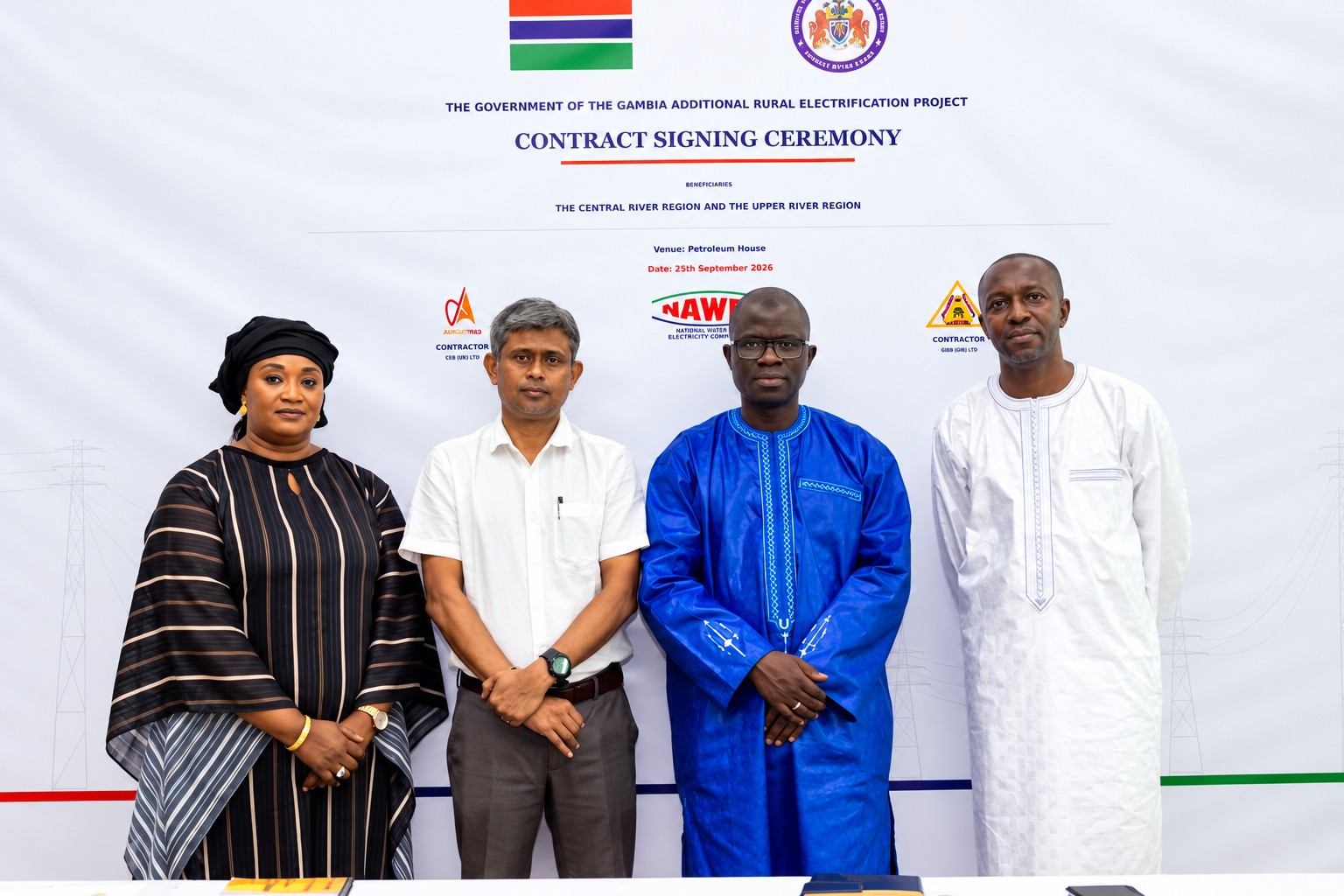
Written by: Dawda Baldeh
EFSCRJ NAWEC Watch, a civil society initiative that monitors the National Water and Electricity Company (NAWEC) and The Gambia’s electricity sector, has questioned the government’s decision to spend $14.1 million connecting 241 more communities to the national grid while the country is still struggling to generate enough electricity for existing consumers.
The group’s argument is simple: extending electricity lines to more communities does not necessarily solve the power crisis if there is not enough electricity being produced to supply everyone connected to the grid.
The contracts, signed on September 25th, 2026, cover communities in the Upper River Region (URR) and Central River Region (CRR). Alpha TND will carry out the CRR component for $8.81 million, while Power Factor Limited will handle the URR component for $5.35 million. The projects will be financed from the national budget.
“While every community has the right to access electricity, it is fundamentally imprudent to connect communities without first ensuring adequate generation capacity,” EFSCRJ NAWEC Watch said.
In other words, the group fears the government could expand the number of people connected to the grid without expanding the amount of electricity available, leaving both old and new consumers competing for an already limited supply.
“The government is effectively building pipes while the well runs dry,” the group said.
It also pointed to The Gambia’s dependence on imported electricity. EFSCRJ NAWEC Watch cited a letter from NAWEC to the Ministry of Finance acknowledging receipt of $24.9 million from a World Bank-funded project to settle arrears owed to foreign electricity suppliers, including Senegal’s SENELEC and Guinea’s EDG.
The group questioned whether it is sustainable for the government to continue spending millions on imported electricity while domestic generation facilities, including the Brikama and Kotu power stations, remain under strain.
“Government is spending millions to sustain external dependence while failing to invest adequately in domestic energy sovereignty,” it said.
EFSCRJ NAWEC Watch has written to the Presidential Taskforce on Electricity Supply, chaired by Vice President Mohammed B.S. Jallow, asking the government to make increased electricity generation the immediate priority before continuing large-scale expansion of the grid.
“The government must prioritize generation,” the group said.