
 11
11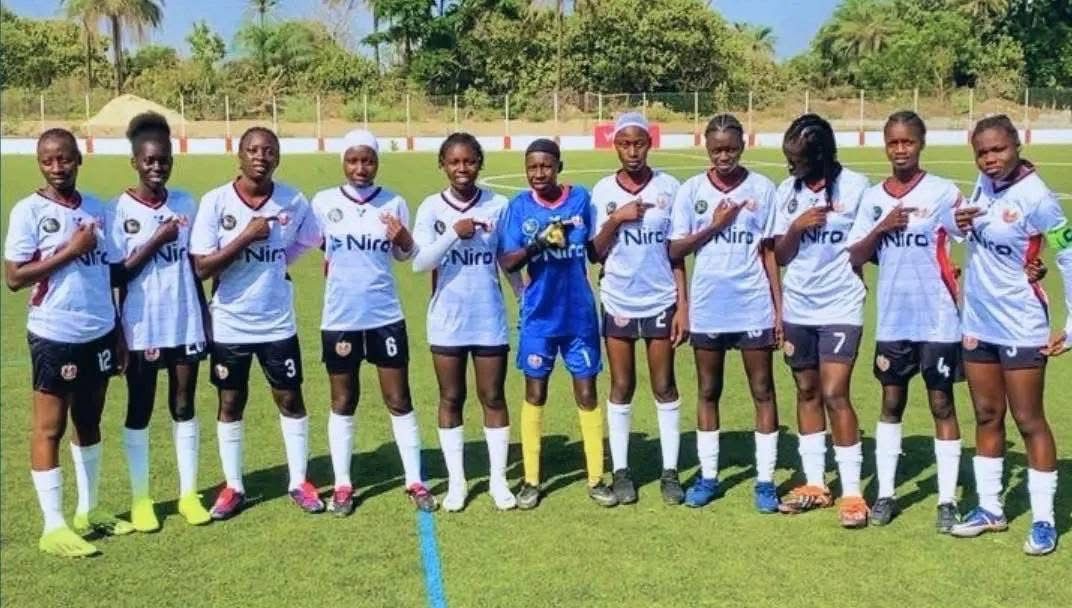
By Fatou B. Camara
The suspension of nineteen (19) female players and seven (7) technical staff members of Greater Tomorrow Women’s Team has raised serious concerns, with many fearing the decision could cause long-term damage to the players’ careers.
The sanctions were imposed by the Organising Committee of The Gambia Football Federation (GFF) in a letter dated February 12, 2026, and later made public on the Federation’s Facebook page on February 19, 2026.
Legal Perspective on the Ban
Gambian sports lawyer Momodou Lamin Bah has questioned whether the sanctions are supported by existing regulations.
He explained that under both general legal principles and the FIFA Disciplinary Code, any sanction must:
Bah noted that he is not aware of any GFF regulation that permits a total ban from all football-related activities for the alleged offences.
A review of the 2019 GFF regulations shows no provision expressly allowing individual player bans of such duration in these circumstances.
Under these rules, responsibility for honouring fixtures lies primarily with clubs not individual players.
Section 10(24) empowers the Organising Committee to sanction clubs that fail to honour fixtures through measures such as:
Fines
Points deductions
Awarding points to the opposing team
Reimbursement of expenses
Similarly, Section 12(4) states that if a team fails to complete 75% of its fixtures, its points may be expunged from the league table.
Bah emphasised that the FIFA Disciplinary Code upholds the principle of legality in sports governance:
“Until a decision is based on legally applicable regulations, it violates the principle of legality and may be vulnerable to appeal before football tribunals, including the Court of Arbitration for Sport (CAS).”
Questions Over Fair Hearing
Peter N. Mendy, the club’s head coach, stated that the circumstances leading to the sanctions were more complex than initially presented, and that key stakeholders including players were not formally engaged before conclusions were reached.
According to Mendy, players had been instructed to temporarily suspend training by the club’s Secretary-General pending investigations into their first match against Berewuleng, complicating claims of a deliberate boycott.
He further alleged that after the club gained promotion to the First Division in the 2024/25 season, management attempted to sell the club without informing the coach or players, although the deal ultimately did not materialise.
On 19 December 2025, Mendy boycotted the club’s opening league match against Berewuleng after discovering that key players had not been registered.
Following this, the club’s Secretary-General, Assan Darboe, issued an audio and written directive via the team’s WhatsApp group instructing all players to halt activities:
“Please, I want to inform everyone on this page that management has decided that all activities of the female team are hereby suspended until further notice, pending the outcome of Federation investigations about our last game.”
Before their next fixture on December 28, 2025, against Red Scorpions, the club announced via Facebook that Mendy had parted ways with the team, with his assistant appointed as interim coach.
Club Withdrawal and Regulatory Action
On January 7, 2026, the GFF confirmed Greater Tomorrow’s withdrawal from the 2025/26 First Division Women’s League, invoking Article 12(5.A) of its rules.
This resulted in the expunging of the club’s points and its relegation to the Second Division for the 2026/27 season.
Collective vs Individual Responsibility
Bah stressed the importance of distinguishing between collective and individual responsibility in sports governance.
He explained that clubs are generally held accountable for the actions of their players and staff, particularly when those individuals act under club authority.
“Failure to honour a fixture is a disciplinary violation. However, CAS jurisprudence requires proof of individual liability before assigning personal responsibility,” he said.
He further argued: “Even if players acted without club authorisation, it is the club, not the federation, that is responsible for disciplining them internally. Competition organisers like the GFF are not legally positioned to impose such individual sanctions.”
He added that under the FIFA Disciplinary Code, when a match cannot take place due to team-related issues, sanctions are typically imposed on the club or association, not individual players.
Players’ Reactions
One affected player, speaking anonymously for fear of repercussions, confirmed that the directive to suspend training did not originate from the coaching staff.
She corroborated the existence of an audio message from the Secretary-General instructing players to halt all activities pending the Federation’s investigation.
“Our coach did not tell us to stop training or refuse to play matches. We were following instructions from the Secretary-General,” she said.
She described the sanctions as devastating: “I was really disappointed and confused. I didn’t even know what to do. Imagine young girls like us, whose football careers are already short, being given a three-year suspension without hearing our side of the story. It really affects us.”
Investigations revealed that two of the nineteen suspended players are minors.
Mariama Baldeh was a minor at the time of the decision (turning 18 five days later), while Fatou Jamneh remains under 18 until September 2026.
Bah noted that minors are afforded special protection in football governance, and their level of autonomy must be carefully considered in disciplinary decisions.
Player Welfare Concerns
Women’s football expert Sainey Mboges urged authorities to prioritise dialogue and investigation over punitive measures.
She warned that a three-year ban could destroy young players’ futures rather than correct behaviour, advocating for mediation and restorative approaches.
“Women’s football is still developing. Governance decisions must reflect not only rules but also responsibility for player welfare and the long-term future of the game,” she said.
Club Owner’s Response
Club owner Benjamin Eze expressed disappointment over the situation, suggesting that dialogue could have prevented escalation. He confirmed that the crisis began when the head coach boycotted the opening match, prompting the Secretary-General to suspend team activities pending investigation. He also revealed that the club was fined 25,000 dalasis by the Federation.
According to Eze, the situation worsened when players refused to return to training, leaving the club unable to field a team and forcing it to withdraw from the league.
“I have been with these players for seven years in the second division. Nobody loves them more than I do,” he said.
Broader Stakeholder Reactions
The President of the Gambia Women’s Football Association, Sainabou Cham, declined to comment in detail, citing ongoing internal consultations.
Adama Jarju, President of Yakarr Football Academy, acknowledged the importance of discipline but stressed that it must be exercised within the law. She described the sanctions as excessive and questioned why individual players were punished after the club had already been sanctioned.
Women’s football advocate Alieu Wenger also criticised the decision, warning that it could discourage aspiring players. He noted that some affected players, including national team member Wuday Colley, risk having their development significantly disrupted.
Attempts to obtain comments from the GFF’s Communications and Competitions Departments were unsuccessful.
Appeal and Revised Decision
An appeal was filed by the affected players and technical staff on February 12, 2026, in accordance with Article 20(1) of the GFF Competition Rules, which guarantees the right to challenge decisions of the Organising Committee. After three weeks and two days, the Appeals Committee delivered its verdict on March 9, 2026.
The Committee found that some players and staff had failed to comply with internal club decisions, including the dismissal of Head Coach Peter N. Mendy and his assistant Abdou Jallow. It described the boycott of league matches as “regrettable and unacceptable,” noting its disruptive impact on both the competition and the club.
The Committee reduced the players’ and five technical staff members’ bans from three years to one year, covering the 2025/26 season. However, the three-year bans imposed on the head coach and his assistant remain unchanged.
Continuing Discontent
Despite the reduced sanctions, dissatisfaction remains among those affected.
Coach Mendy maintained that the players do not deserve any suspension: “We don’t want favours, we want justice.”
Team captain Wuday Colley expressed frustration, noting that the sanction has already affected her career. As a national youth team player, she missed selection for the Women’s U-20 WAFU A tournament.
“It is not fair. We were not acting deliberately, we were following instructions. We were never given a chance to be heard,” she said.
Although the ban was reduced to one year, she insists it remains unjust: “We don’t deserve even a second of suspension, talk less of one year. But this will not stop my fighting spirit. I believe one day all of this will pass.”