
 11
11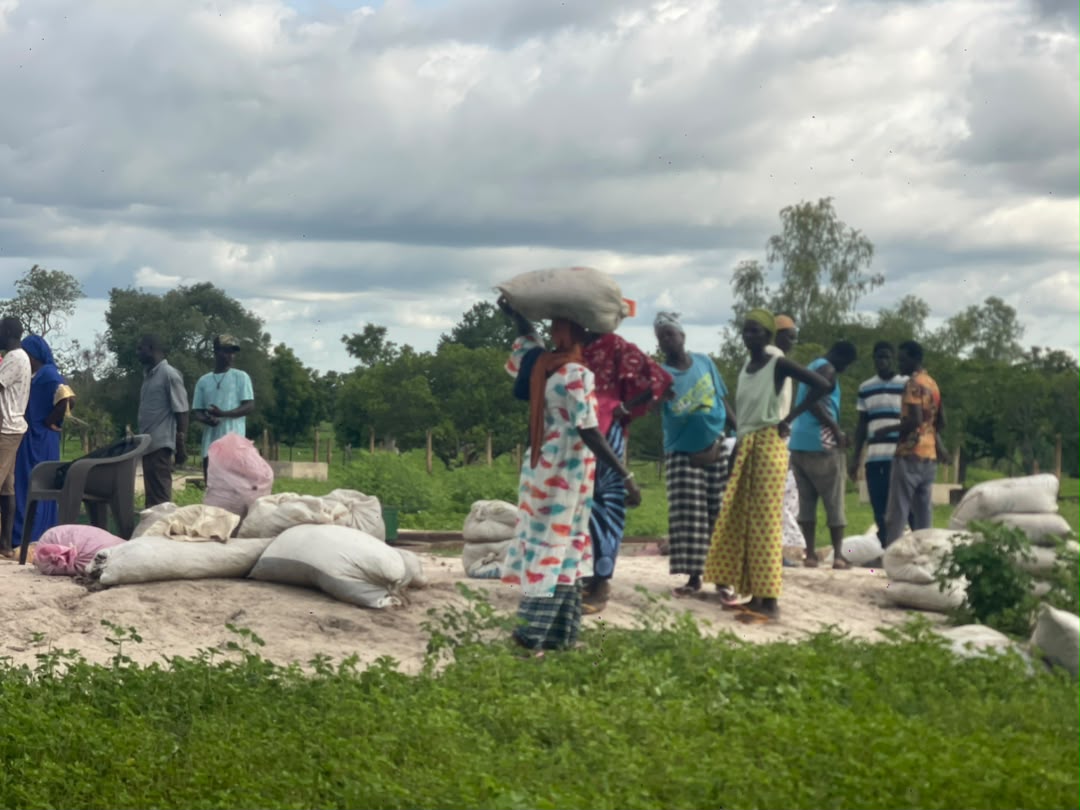
By Dawda Baldeh
ActionAid International, The Gambia has distributed more than 1,000 bags of locally produced organic fertilizer to more than 500 farmers in the North Bank Region (NBR) and Central River Region (CRR), in an effort to promote sustainable agriculture and reduce farmers’ reliance on costly chemical fertilizers.
The distribution, held on Wednesday, August 19, is being implemented under ActionAid International The Gambia’s EU-funded SAPOF Project, Strengthening CSO Support & Advocacy for Sustainable Production and Use of Organic Fertilizers.
Farmers in Sare Birom, Upper Niumi District, and Balangarr in Central River Region North are among the beneficiaries of the initiative.
In Balangarr, 250 farmers from Ballanghar Kerr Katim, commonly known as Ballanghar Wolof; Ballanghar Kerr Saul, also known as Kerr Nderry or Kerr Tukulor; and Ballanghar Wharf Town, also known as Ballanghar Tenda, benefited from the intervention.
The support follows the establishment of community compost chambers and the production of organic fertilizer, providing farmers with locally available and more affordable alternatives to chemical fertilizers.
For beneficiaries, the initiative comes at a critical time as farmers continue to face rising agricultural input costs.
They said the intervention could help improve productivity, protect soil health and strengthen sustainable farming practices.
Speaking to The Fatu Network, the Alkalo of Ballanghar Kerr Katim, Alhagie Ass Touray, described the intervention as timely, particularly amid the increasing cost of chemical fertilizer.
Mr. Touray, who is also a seasoned farmer, commended ActionAid for training community members to produce organic fertilizer using animal waste and other locally available materials.
“Most farmers struggle to buy chemical fertilizer,” he said, stressing the importance of promoting affordable and locally produced alternatives.
ActionAid International The Gambia’s SAPOF Project Director, Saikou F. Bah, said the organisation had established a composting site in the village garden to enable residents to produce organic fertilizer for their farms.
“We are presenting one thousand bags of organic fertilizer to the farmers. Each four bags will cover half a hectare. Each one of you will get four bags of 17.5kg each, and eight bags can cover a hectare,” Bah explained.
He urged farmers to apply the fertilizer according to the recommended quantities to achieve maximum results.
“If you are given [fertilizer] for half a hectare, don’t use it for a hectare because that way you won’t get the best,” he cautioned.
Bah also encouraged residents to see compost production as more than an agricultural activity, describing it as a potential source of income for the community.
“Everything we used to make these organic fertilizers is available within our communities. Take this seriously and continue making the organic fertilizers,” he urged.
According to Bah, the compost produced by the community has the potential to generate up to 2,000 bags of 17.5kg organic fertilizer. If each bag is sold for D350, he said, the community could potentially generate D700,000 from a single production cycle and up to D1.4 million annually.
Women leaders in the community also welcomed the initiative.
Aja Touray described the training as “a huge step” for local farmers, saying the organic fertilizer would benefit both their gardens and farms.
“Learning how to make compost fertilizer is a huge step for us as farmers. These organic fertilizers will help us a lot. Now we will continue using it in our gardens and farms,” she said.
She also described compost production as a potential business opportunity and pledged the community’s commitment to sustaining the initiative.
Another beneficiary, Aji Hawa Touray, expressed gratitude to ActionAid, saying the intervention could help residents generate additional income while improving agricultural productivity.
Farmers who benefited from the initiative said they were encouraged by the results they had witnessed since ActionAid introduced organic fertilizer to the community last year.
According to the beneficiaries, the use of organic fertilizer has already produced noticeable improvements in their farms, strengthening their confidence in sustainable and locally driven agricultural practices.
The SAPOF initiative is therefore expected to reduce farmers’ dependence on costly agricultural inputs while strengthening community-based fertilizer production, improving soil health and creating new income-generating opportunities for rural communities.