

 11
11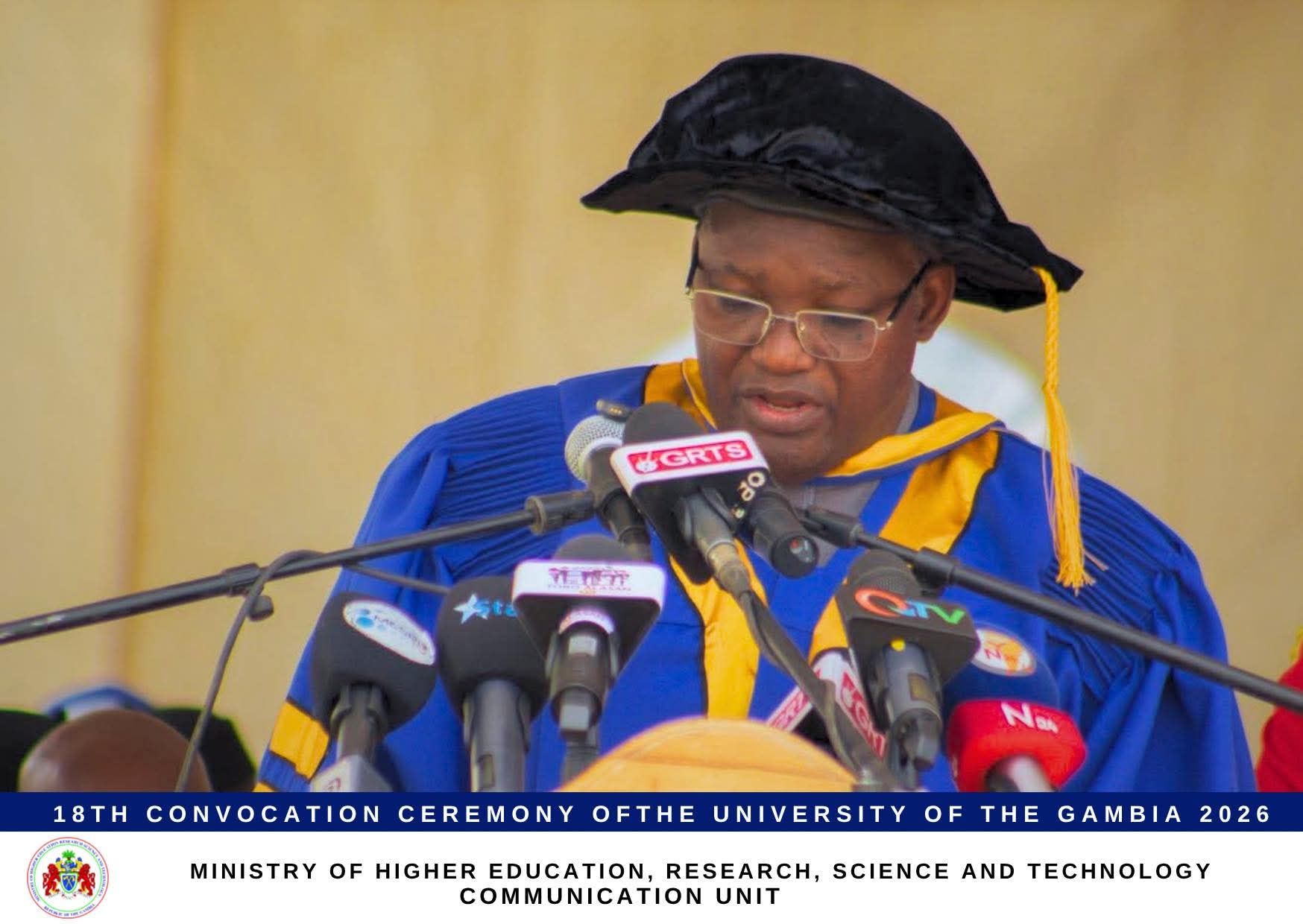
Written by: Alieu Jallow
President Adama Barrow has called on the University of The Gambia (UTG) and other higher-education institutions to take a leading role in shaping national policy, reducing reliance on foreign expertise, and delivering solutions to the country’s most pressing challenges.
Delivering his address at UTG’s 18th Convocation Ceremony at the Faraba Banta Campus, the President said The Gambia’s development ambitions depend on strong institutions capable of generating knowledge to guide policy, legislation, and national programmes.
“I challenge the UTG and all our universities to take the lead in shaping public policy discourse, reducing our reliance on external expertise, and helping to solve our pressing national challenges. The Gambia’s development ambitions demand strong institutions that generate knowledge to propel policy development, legislation, public programmes, national strategies, strategic decision-making processes, and inclusive development,” he stated.
Barrow stressed the importance of collaboration between government, academia, industry, and development partners. He said stronger links between knowledge producers and end-users are essential for national progress.
He also pointed to the urgency of innovation in a rapidly changing global environment shaped by technology, artificial intelligence, climate change, and shifting labour markets. He said innovation is key to economic diversification, national competitiveness, and social progress.
“Consequently, innovation is indispensable for national competitiveness, vital for economic diversification, and essential for social progress. In this context, our universities must nurture graduates who are creative, adaptable, and solution-driven. To support innovation, we need to strengthen the bridge between universities and the private sector and move decisively toward co-creation,” he said.
The President reaffirmed his government’s commitment to research and innovation. He cited initiatives such as the Tertiary and Higher Education Trust Fund, the National Research and Innovation Fund, and the Students’ Revolving Loan Scheme as part of efforts to strengthen the sector.
He added that building incubation and innovation hubs through stronger university-industry partnerships will be key to turning ideas into practical solutions and economic opportunities.
Against the backdrop of persistent unemployment, particularly among young people, Barrow urged universities to go beyond preparing graduates for traditional employment and instead equip them with job-creation skills.
The Gambia continues to face a significant unemployment challenge, driven by limited job creation and a growing youth population. Many young people remain in low-paying informal work. He said this reality requires a shift towards entrepreneurship and innovation-led growth.
“Job creation cannot be left to government alone. It requires a dynamic ecosystem in which higher-education institutions play a central role. Again, I challenge the UTG and other in-country universities to prepare graduates for our labour market, graduates who can create new opportunities through innovation-led entrepreneurship. From this perspective, higher education must not only prepare for the future of The Gambia, but actively build that future, beginning now,” he added.
The 18th convocation marks a milestone for UTG, bringing together graduates, academics, and policymakers at a time when the role of higher education in national development is under renewed focus.