
 11
11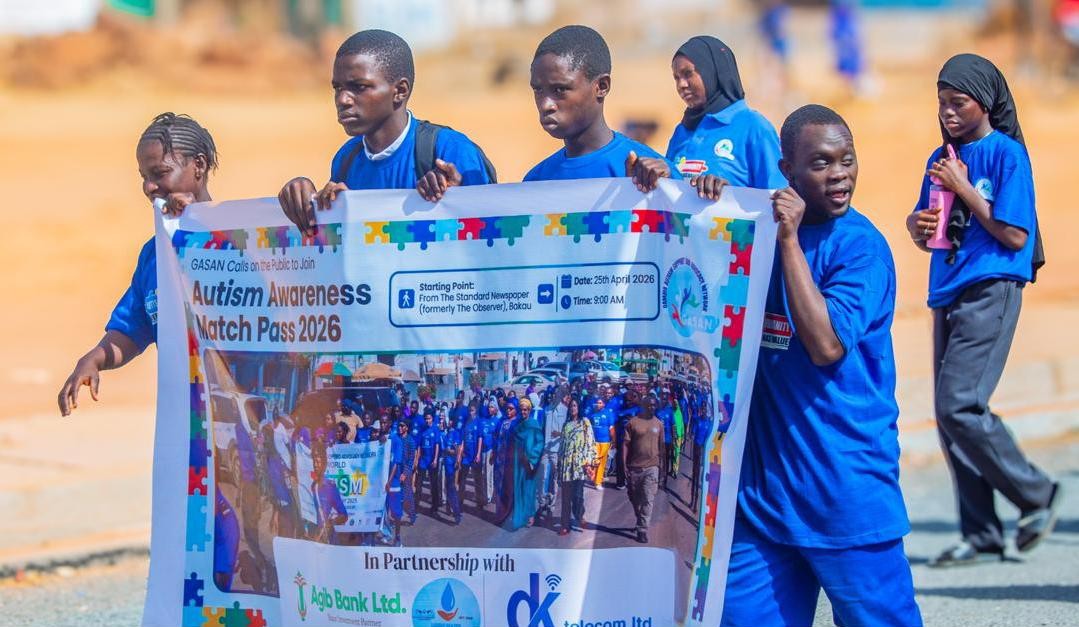
By: Dawda Baldeh
A coalition of advocates has called for inclusion, collaboration, and systemic reform to eliminate discrimination against autistic children, urging society to reject harmful misconceptions that portray them as evil or possessed by devils.
The call was made at a high-level autism engagement event organised by the Gambia Autism Support and Advocacy Network on Saturday, April 26th.
The awareness campaign began with a march and brought together government officials, educators, health professionals, and advocates, all united in a shared goal to build a more inclusive society for people living with autism.
“Today signifies not just an event, but a collective commitment to promoting autism inclusion in The Gambia,” said Awa Touray, the event’s moderator. “We envision a supportive environment for individuals with autism and their families.”
The event moved beyond ceremony, with speakers stressing the importance of dialogue, partnerships, and policy action.
In an exclusive interview with The Fatu Network, Abdoul Majid Jallow, National Coordinator of the Gambia Autism Support and Advocacy Network, firmly rejected societal myths surrounding autism.
“They are not evil or devil-possessed,” he said. “They have a neurological developmental disorder. We view them as abnormal, and they perceive us the same way. They are highly intelligent.”
Jallow also stressed the responsibility of parents and the value of collaboration.
“This platform offers us a valuable chance to engage in dialogue, share experiences, and strengthen collaboration,” he said. “These partnerships can shape policy development, enhance inclusive education, and improve service delivery.”
A high-level panel discussion featured inclusive education consultant Yassin Sosseh, Banjul North National Assembly Member Modou Lamin Bah, and Dr. Mustapha Bittaye, Chief Medical Director of Edward Francis Small Teaching Hospital.
Across the discussions, a clear theme emerged: while frameworks exist, major gaps remain in implementation and capacity.
Addressing inclusive education, Aida Badjie Colley, MSc Child and Adolescent Mental Health Senior Education Officer at the Ministry of Basic and Secondary Education (MoBSE), said existing policies address disabilities broadly but lack specific focus on autism.
“The policy advocates for learners with special needs, not exclusively autism,” she said. “However, we continue to face significant challenges, particularly in capacity building, teacher training, and data availability.”
She acknowledged growing awareness but stressed the need for expert support.
“We require organisations and specialists to assist us in building capacity. Awareness is growing, but support systems must keep pace.”
From a legislative standpoint, Modou Lamin Bah said autism remains largely absent from national budgeting.
“To be clear, there is no specific budget line addressing autism,” he said. “We do have allocations for mental health, but they are insufficient.”
He added that responsibility for introducing budget proposals lies with the executive.
“It is the Ministry’s responsibility to introduce budget lines. Our role is appropriation, but we need those proposals first,” he said. “I am dedicated to becoming an autism champion in Parliament. Advocacy like this is crucial for driving change.”
Yassin Sosseh emphasised that progress must begin with teachers.
“Before we discuss materials or classrooms, we need trained teachers,” she said. “That is the foundation of everything.”
She outlined practical, low-cost strategies such as visual aids and structured instruction but maintained that training remains the priority.
“Children with autism need understanding, not punishment,” she said. “You cannot support a child without understanding their needs.”
She also called for broader societal involvement, stressing the need for coordinated support across sectors.
Despite ongoing efforts, progress in teacher training has stalled due to funding constraints.
“For the past three years, we have been unable to continue training due to financial limitations,” Mrs. Badjie Colley said. “We cannot do it alone; we need partnerships across ministries and organisations.”
She stressed the need for a holistic approach involving schools, families, and communities.
“What a child learns in school must continue at home. Parents, teachers, and communities must collaborate,” she said.
From a health perspective, Dr. Mustapha Bittaye pointed to improvements in early diagnosis but noted ongoing limitations.
“We are just beginning specialised screening,” he said. “Training specialists takes years, and they are not yet available nationwide.”
He added that while referrals are possible when symptoms are identified, access to specialised care remains limited.
“We collect and analyse data at higher levels, but it is not yet fully integrated into national systems,” he said.
The discussion concluded with a call for stronger accountability and full implementation of existing laws, particularly the Persons with Disabilities Act 2021.