
 11
11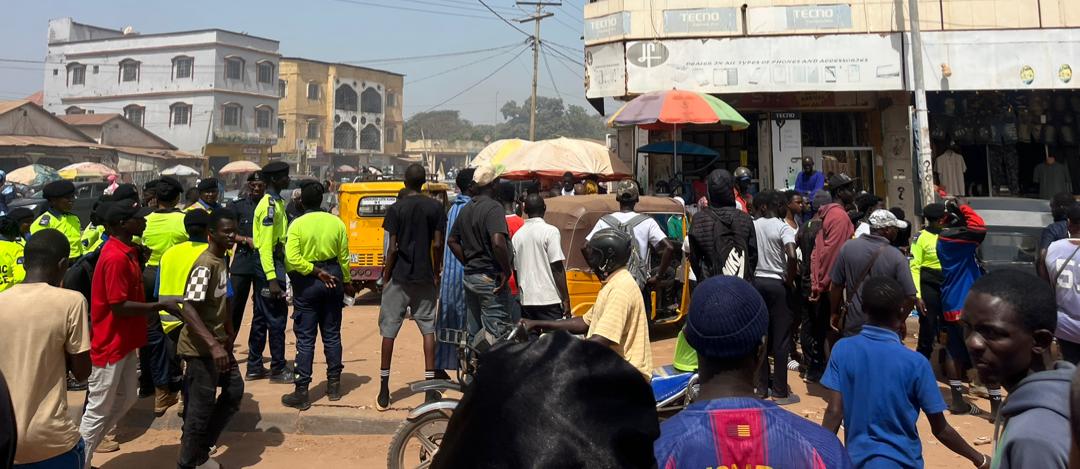
Written by: Alieu Jallow
Hundreds of commuters were left stranded along the busy Latrikunda–Serrekunda highway on Saturday after traffic police launched a crackdown on commercial vehicles, including locally known “batch cars” and taxis, following a clash between drivers a day earlier.
The enforcement action comes in the wake of rising tensions between batch car operators and taxi drivers, whose rivalry over passengers and operating space has increasingly disrupted movement along one of the country’s busiest urban corridors.
The tricycles, private vehicles informally used for commercial transport, have become a common feature on major routes, particularly in high-demand areas where public transport remains insufficient. While they offer a cheaper and more flexible option for commuters, their operations often fall outside formal regulation, bringing them into conflict with licensed taxi drivers and transport authorities.
Friday’s confrontation between the two groups reportedly escalated along the Latrikunda–Serrekunda stretch, prompting swift intervention from the Gambia Police Force.
In an exclusive interview with The Fatu Network, Commissioner of Traffic Lamin King Colley said the police acted on intelligence reports about the severity of the clash, describing their intervention as both timely and necessary.
“If drivers and ‘keke’ operators occupy areas without due legal process, it becomes incumbent on the police to intervene. That is our role,” he said, noting that the area in question is not designated as a parking or operational zone for such vehicles.
Commissioner Colley further explained that when tricycle transport, commonly known as “keke”, was introduced in 2022, operators were restricted to specific areas, including Manjai, Dippa Garage, Kotu, and Kololi, excluding the Latrikunda–Serrekunda highway due to congestion and population density.
He emphasised that the current situation reflects a violation of those initial agreements, adding that authorities are taking proactive steps to prevent further disorder and potential criminal activity.
“We are engaging the leadership of the drivers at Bundung Police Station to dialogue on the way forward. I will submit my report to my authorities early next week, Monday or Tuesday, for a final decision,” he stated.
The operation also exposed other traffic violations. In a related incident, a private vehicle being used as a commercial taxi was impounded for operating with an unauthorised tinted windscreen, in breach of traffic regulations.
Citing Section 25(c) of the Traffic Act, Commissioner Colley noted that tinted windscreens require authorisation from the Inspector General of Police and are generally not permitted on commercial vehicles.
“For example, this taxi is operating as a commercial vehicle and is fully tinted, which is a violation of the Traffic Act. Section 25(c) states that a person shall not cause or permit a person to drive a vehicle with a pasted tint unless authorised to do so by the Inspector General of Police. Even the Inspector General would not authorise tinting on a commercial vehicle, it is only permitted for private or government vehicles,” he explained.
As enforcement continues, many commuters have been left scrambling for transport, highlighting the fragile balance between regulation and the daily transport needs of the public.
Commissioner Colley has urged all road users to comply with the law, warning against unlawful practices as the country approaches a politically sensitive election period.