
 11
11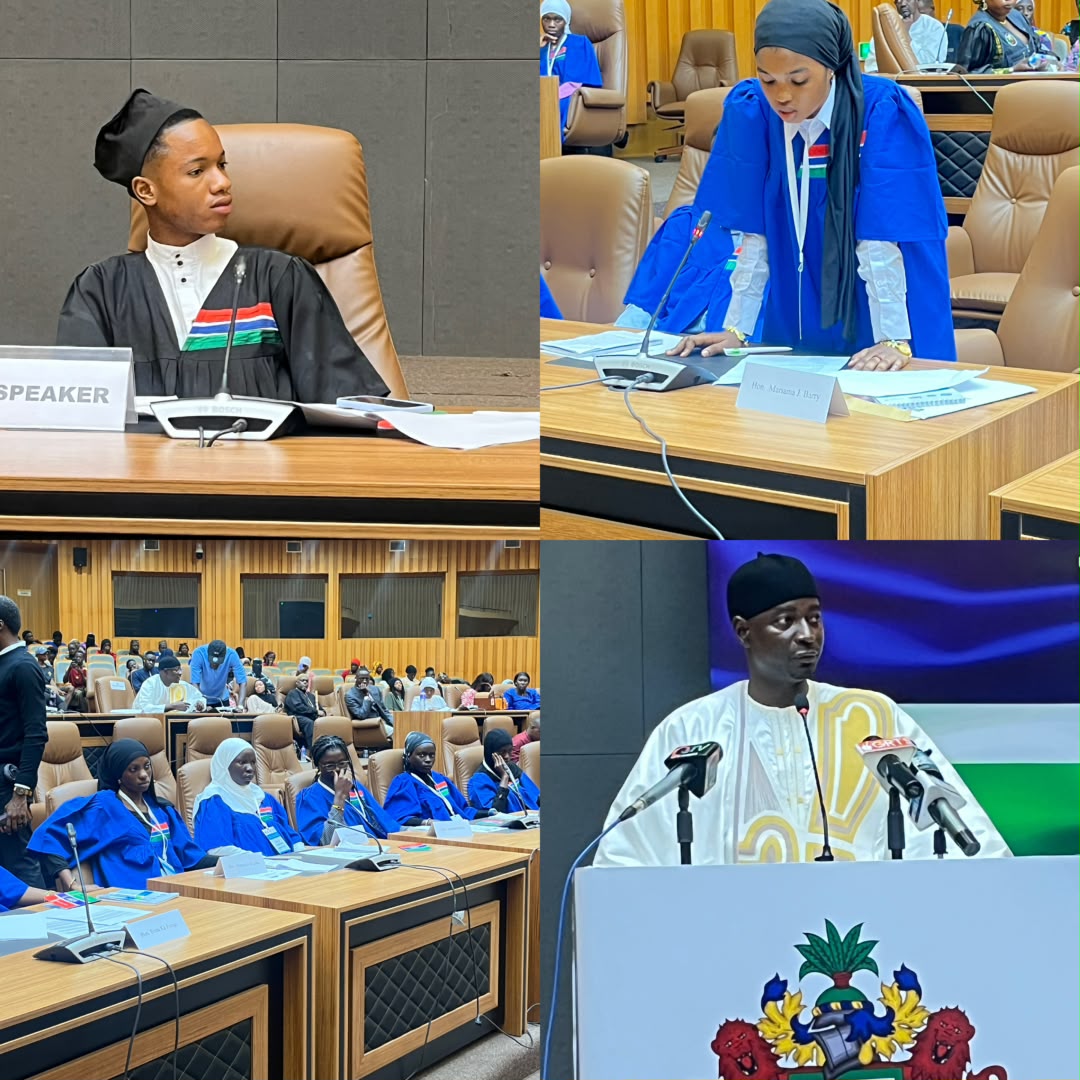
By Alieu Jallow
Young representatives from across The Gambia urged the government on Friday to turn promises into action after the Children’s National Assembly held its first annual sitting and presented a formal Call to Action to ministers, saying current mechanisms fail to track whether recommendations are implemented.
Held at the Sir Dawda Kairaba Jawara International Conference Centre under the theme “Investment, Accountability & Participation for Every Child,” and supported by UNICEF and the National Youth Council, the assembly saw delegates press officials on child‑rights violations, violence, abuse, discrimination, child marriage, disability inclusion and the lack of safe recreational spaces.
Speaker Babacarr Sowe said the assembly’s own assessment found that, while recommendations are developed and submitted to ministries, “there is currently no structured mechanism to track their implementation, monitor progress or publicly report on actions taken in response.” He added: “Although we have seen encouraging progress on many issues affecting children, we cannot confidently see how much of that progress resulted directly from the advocacy of the Children’s National Assembly.” He called for a follow‑up system to let children monitor commitments and verify that recommendations become concrete action.
Delegates stressed that investment must be paired with accountability. Binta Fatajo, Member for the North Bank Region, said policies and programmes must be implemented, monitored and evaluated so “every child benefits, regardless of gender, disability, location or socioeconomic background.” She told the assembly: “Those entrusted with safeguarding children’s rights must remain accountable for fulfilling their commitments. Furthermore, children should not only be seen as beneficiaries of development, but as active partners in shaping it.” She added: “We have ideas, experiences and perspectives that can contribute meaningfully to decisions affecting our education, health, protection and overall well‑being.”
Local concerns featured strongly. Awa Jallow, representing Banjul, warned that the capital is losing safe play spaces and cited Article 31 of the Convention on the Rights of the Child. She highlighted the deteriorating condition of McCarthy Square and asked: “So now, the question is not what the problem is. The question is, what concrete steps are being taken to ensure that the children of Banjul do not access over-18 spaces, or what has been done to ensure that McCarthy Square has been restored or a safe recreational centre provided for the children in Banjul?”
Sukai B. Bojang of the West Coast Region raised concerns about inclusive education after describing a case in which a hearing‑impaired pupil was reportedly denied access to the WASSCE Oral English exam. Invoking Article 23 of the Convention on the Rights of the Child, she said: “Honourable Speaker, I believe this assembly believes advocacy is indeed a strong weapon, but it is now time for accountability. I therefore call for accessible alternatives in the WASSCE English examination, because this ability should never be a disqualification.”
Calls for stronger enforcement of child‑protection laws were echoed by Kaddijatou Darboe, who urged tougher action against child marriage: “The Children’s National Assembly of The Gambia recognises that child marriage is legally prohibited in our country and calls for stronger enforcement of the laws that protect children. Yet laws alone are not enough if they are not implemented and enforced.” Mariama Anta Secka from the Central River Region also pressed for measures to promote inclusion and protect every child’s rights.
Addressing the assembly, Deputy Speaker Seedy S.K. Njie said involving children in the legislative arena strengthens democracy and nurtures active citizenship. “Today, you sit in this hallowed Chamber not as passive observers, but as ambassadors and representatives. You carry on your shoulders the hopes, the concerns, and the brilliant aspirations of millions of children from every region, town and village across The Gambia,Your responsibility over the course of this session is therefore immense: you must use this platform wisely, to debate respectfully, to listen intently and to express your convictions with unwavering confidence and maturity,” he said.
The sitting closed with the Children’s National Assembly formally placing its Call to Action before the Minister of Gender, Women and Children Affairs. Delegates left with a clear message: children want more than consultation — they want their recommendations acted upon, monitored and publicly accounted for. The next test will be whether government responses translate into measurable change in communities across the country