
 111
111 2
2 3
3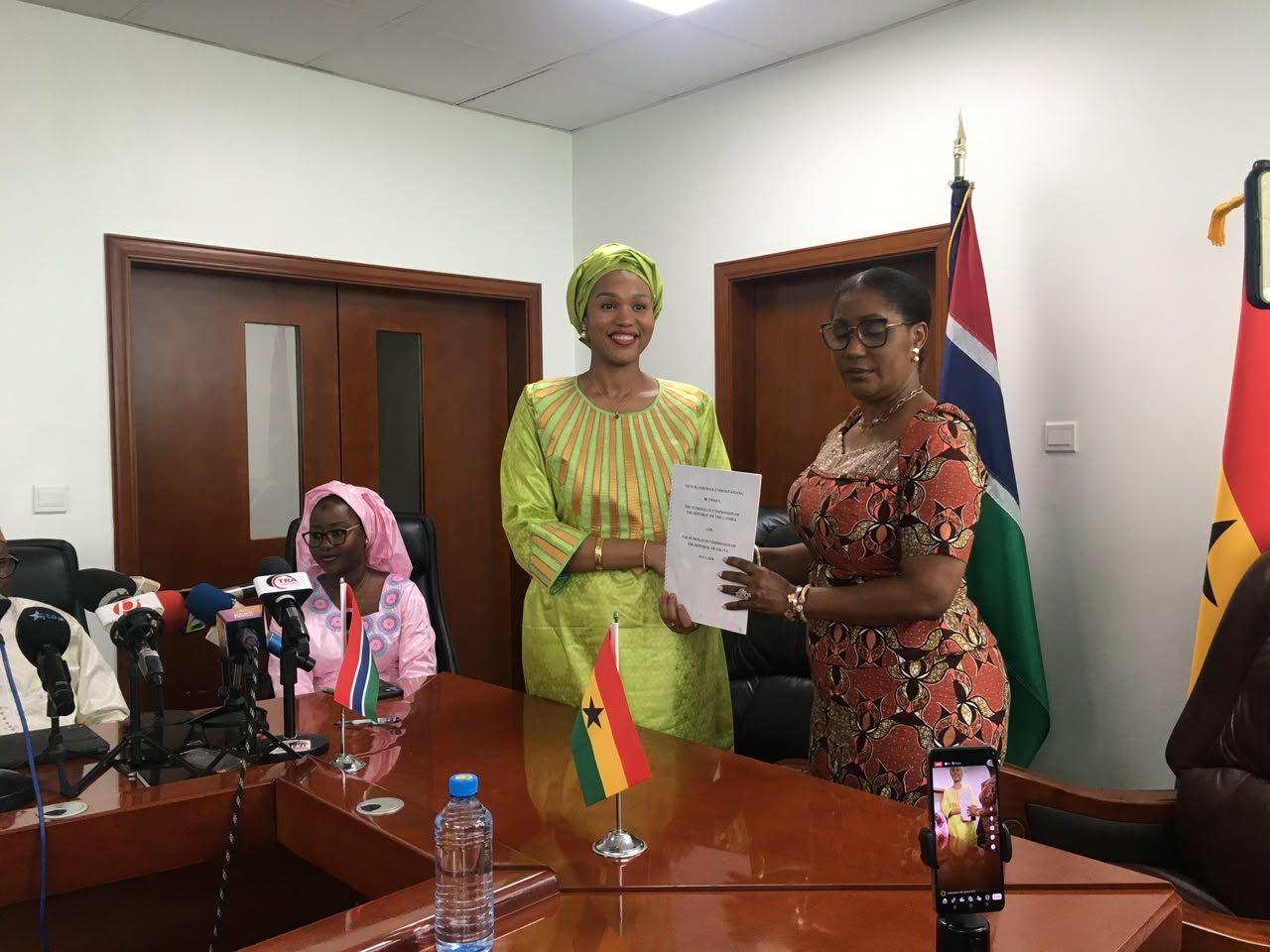
By Dawda Baldeh
The Gambia and Ghana have signed a historic cooperation agreement to tighten oil and gas regulation, with energy chiefs warning African nations against a “race to the bottom” to attract Western investment.
The Memorandum of Understanding (MoU), signed at Petroleum House in the Gambian capital of Banjul, formalises years of informal collaboration between the Petroleum Commission of The Gambia and the Petroleum Commission of Ghana. The landmark pact focuses on critical knowledge sharing, technical exchanges, licensing, data management, local content development, environmental oversight, and institutional governance as The Gambia seeks to transform itself into a major commercial oil and gas producer.
Speaking at the signing ceremony, Cany Jobe, the Director General of the Petroleum Commission of The Gambia, emphasized that while the nation remains in the early stages of oil exploration, building robust state oversight is vital to avoiding the “resource curse” that has plagued other developing economies.
“Today’s ceremony marks an important moment for our two institutions. It is not simply the signing of a document, but the formalisation of a relationship that has spanned years of cooperation, collaboration, and that we hope will become even more practical, active and beneficial to both commissions and our countries,” Joof said.
Highlighting the need for rigorous regulatory structures before major deposits are tapped, she added: “A country may discover petroleum, but without capable institutions, clear rules, technical discipline, public trust and responsible oversight, the opportunity can easily be weakened.”
Jobe pointed to Ghana’s own long journey to production as a roadmap for patience, noting that its exploration history dated back to 1896, but its world-class Jubilee discovery came more than a hundred years later after decades of technical work and institutional development.
“Petroleum development requires a lot of patience and persistence. Ghana’s success did not happen overnight,” Jobe remarked, stressing that the true measure of the deal “will not be the signatures, but the work that follows, the exchanges that take place, the capacity it will build, the systems it will strengthen and the opportunities we will create for those who will serve in this sector after us.”
The alliance comes at a precarious time for frontier African producers, who are facing a sharp decline in global fossil fuel financing due to the international transition toward green energy. Emeafa Hardcastle, the Chief Executive Officer of Ghana’s Petroleum Commission, stated that African regulators must increasingly rely on continental solidarity rather than looking to Europe or North America for guidance.
“There are challenging times ahead of the industry for resource-producing countries, especially frontier and new producers. There has been a crunch in investments due to the green transition, and for that we are grateful that we can form relationships with frontier countries, especially in Africa, to support one another,” Hardcastle said.
“It’s not always that we have to go to Europe or North America for assistance. We in Ghana are a little longer in the journey than you, but the peer learning and benchmarking that we can do amongst ourselves is important,” she added.
Hardcastle issued a stark warning against African nations undercutting one another by weakening environmental laws or offering overly generous tax breaks to multinational corporations in a desperate bid for capital.
“Many African countries are racing to the bottom in an attempt to attract more investment. We keep lowering our fiscal terms and regulatory requirements, but at the end of the day we end up competing amongst ourselves. There is a need for oil and gas-producing countries, especially new producers, to cooperate and optimise the benefits of our natural resources,” Hardcastle warned.
She concluded that the real work of converting the agreement into on-the-ground results begins immediately: “Today’s signing of the MoU is more than a formal act. It’s a landmark moment and a powerful symbol of our mutual commitment to a brighter future. The important task of turning the commitments in our MoU into meaningful, on-the-ground results starts from today.”
The Gambian government has thrown its full political weight behind the accord. Abdoulie Jallow, Permanent Secretary representing the Ministry of Petroleum, Energy and Mines, stated that the partnership reflects deep historical ties and demonstrates the tangible value of South-South cooperation.
“Today’s Memorandum of Understanding represents much more than the signing of a document. It symbolises our shared commitment to cooperation, institutional excellence and the belief that African countries can accelerate their development by learning from one another and working together,” Jallow said.
Echoing the sentiments of the regulatory chiefs, Mr Jallow promised that the ministry would provide continuous policy guidance to ensure the deal transitions into concrete, measurable programmes.
“We will continue to provide the necessary policy guidance and institutional support to ensure that the objectives of this partnership are realised. We encourage both institutions to translate the commitments contained in this Memorandum of Understanding into concrete programmes, measurable outcomes and lasting impacts,” he said.
“The true measure of this Memorandum will not be in the signatures we append today, but in the partnerships we strengthen, the knowledge we share, the capacity we build and the opportunities we create for future generations,” Jallow concluded.


