
 11
Written by: Seringe S.T. Touray
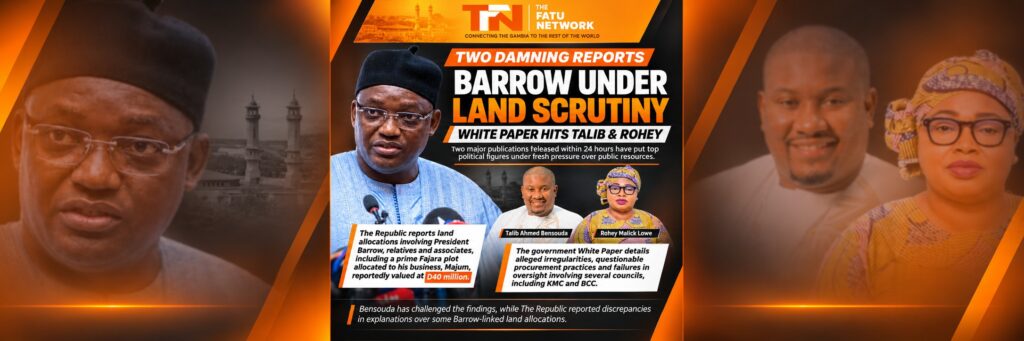
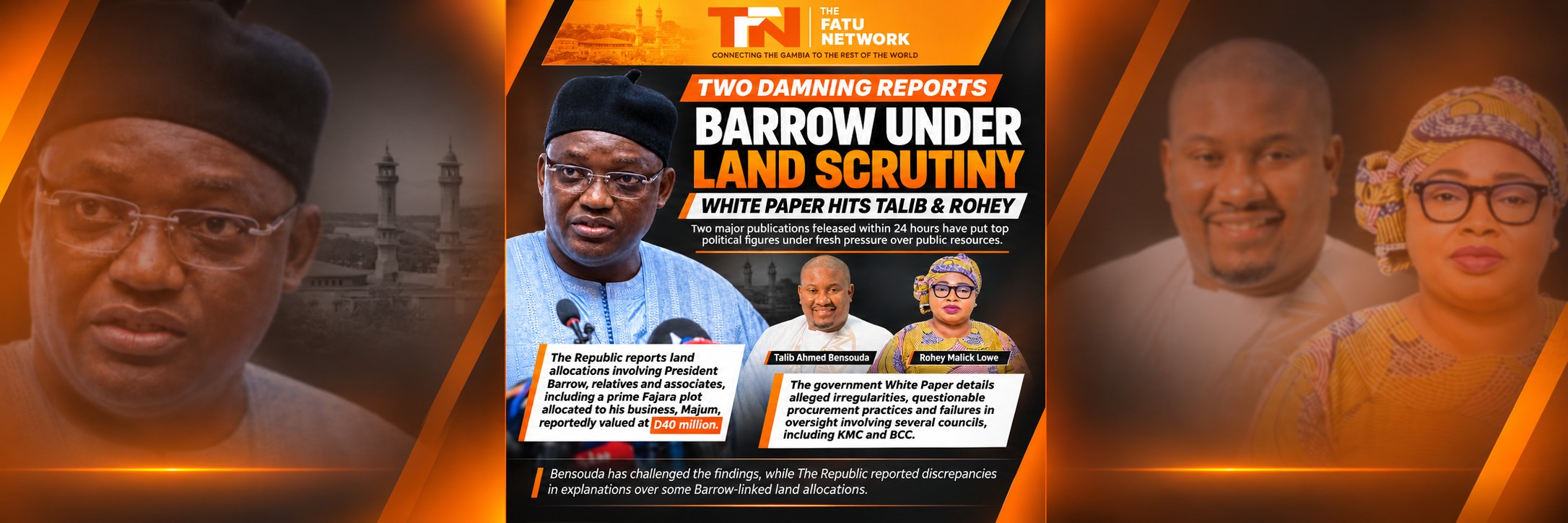
Two major publications released within a day of each other have raised serious questions about the management of public resources involving President Adama Barrow, members of his family and political circle, and prominent local government officials, just weeks before The Gambia’s December 5 presidential election.
On Thursday, 29 October, the government published its White Paper on the Local Government Commission of Inquiry, outlining allegations, adverse findings and proposed action against officials from several councils, including Kanifing Mayor Talib Ahmed Bensouda and Banjul Mayor Rohey Malick Lowe.
The White Paper raised allegations of procurement irregularities, questionable financial approvals and failures in oversight. In Bensouda’s case, the commission reportedly raised concerns over D13.1 million in additional costs linked to the D105 million Mbalit waste truck procurement. The government subsequently directed a police investigation, forensic audit and proceedings concerning his removal from office.
President Barrow had previously promised that the government’s handling of the inquiry would respect due process.
“Accountability must be fair, objective, and guided by the principles of natural justice,” he said when receiving the commission’s report in May.
Bensouda, however, has rejected the commission’s conclusions and accused the government of interfering with the report. His political allies have also questioned the timing of the White Paper, describing it as “a weak, last-minute political manoeuvre intended to confuse the public”.
A day after the White Paper’s publication, The Republic released an extensive investigation titled Soil for the Elites, examining how President Barrow, members of his family and other influential individuals reportedly benefited from multiple state land allocations.
According to The Republic, official land records show three residential allocations in Barrow’s name and two additional allocations to his sole proprietorship, Majum, between 2017 and 2025. The newspaper cited regulations stipulating that state land allocations “shall be one plot per person”, raising questions about whether the President’s multiple allocations complied with the law.
One commercial plot allocated to Majum in Fajara on 2 April 2024 was conservatively valued by the Lands Ministry at D40 million, the newspaper reported.
The allocation reportedly came approximately three months after car dealers were ordered to vacate part of the area during a government road-clearing exercise. One of the displaced dealers accused the authorities of favouring influential individuals, telling The Republic: “It’s clear we were evicted simply because we lacked influence.”
The investigation also cited findings from government-commissioned inquiries into the allocation of land within the protected Tanbi Wetland National Park, including the Kamalo area.
According to The Republic, one inquiry found that government authorities had allocated plots in protected wetland areas without first obtaining the necessary legal approvals to remove their protected status. Investigators reportedly concluded that land allocations and developments carried out without those approvals were legally invalid.
Another inquiry reportedly found that land in Kamalo had been allocated without proper environmental assessments, exposing the protected wetlands to potential destruction and pollution.
The investigation also raised questions about transparency in the allocation process, citing an inquiry which found that the government did not routinely announce the “availability of land prior to allocation” to ensure “equal opportunity” for members of the public.
In another serious allegation, The Republic reported that President Barrow had been accused of interfering with a state audit into government land allocations.
Former Auditor General Modou Ceesay reportedly testified before the Supreme Court that the President repeatedly summoned him to State House and questioned the scope of an audit covering land allocations between 2021 and 2025.
“He was specifically concerned why we chose the scope from 2021 to 2025,” Ceesay testified, according to The Republic.
The newspaper reported that Barrow himself received at least two state land allocations during the period under investigation. It also cited an unnamed State House source who alleged that the Presidency became concerned after auditors requested information about land allocated to the President and other individuals.
Ceesay was removed from office in September 2025, a decision the Supreme Court ruled unconstitutional in July 2026. However, the court’s ruling concerned the legality of his removal and did not establish that President Barrow interfered with the audit.
In an earlier statement, State House maintained that Ceesay’s proposed appointment as Trade Minister was based on his qualifications and was not intended to interfere with the National Audit Office.
According to The Republic, the land audit remained unfinished as of October 2026, with the National Audit Office attributing the delay to unresolved internal technical discussions.
The Republic further reported that Lands Minister Hamat Bah had claimed President Barrow rejected two Brufut land allocations in favour of a property in Fajara. However, the newspaper said the official government records it examined continued to list both Brufut plots under Barrow’s name, raising questions about the minister’s explanation.
The newspaper said the Presidency had not responded to its request for comment by the time of publication.
The two publications have brought renewed scrutiny to the handling of public resources at a politically sensitive time, raising questions about financial oversight, state land allocations and accountability among those entrusted with public office.
The allegations and adverse findings contained in the publications remain subject to the relevant legal processes and do not, by themselves, establish criminal guilt.